
 +91 98440 40401

Industry 4.0From Assembly Lines to Autonomous Systems in Factory Automation
23 March 2026
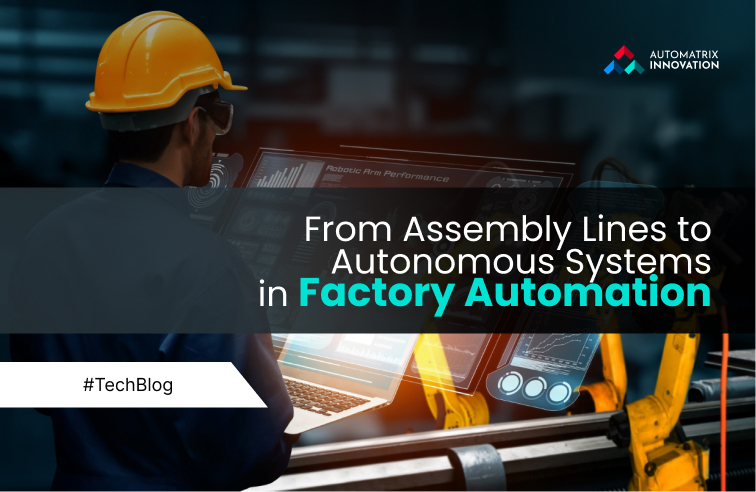
The Evolution Manufacturing Can’t Ignore
What if your factory is automated—but still not intelligent?
For decades, factory automation has been synonymous with efficiency. Assembly lines replaced manual labor, machines improved speed, and rule-based systems brought consistency to manufacturing processes. This transformation helped industries scale production and reduce operational costs. However, the demands of modern manufacturing have changed significantly.
Today’s factories operate in an environment defined by volatility, complexity, and constant change. Fluctuating demand, supply chain disruptions, and increasing customization requirements mean that static systems are no longer sufficient. Traditional factory automation, while effective for repetitive tasks, lacks the ability to respond dynamically to these challenges.
As a result, many enterprises find themselves in a paradox—highly automated operations that still struggle with delays, inefficiencies, and limited visibility. The issue is not the absence of automation, but the absence of intelligence within those systems.
From Assembly Lines to Autonomous Systems
Factory automation is undergoing a fundamental transformation. It is moving beyond machines executing predefined tasks toward systems capable of autonomous decision-making and real-time execution.
Modern factory automation integrates data, workflows, and control systems into a unified, intelligent environment. This shift enables manufacturers to monitor operations continuously, adjust production dynamically, and coordinate processes seamlessly across the factory floor.
Instead of relying on linear assembly lines, factories are evolving into interconnected ecosystems where systems communicate, adapt, and optimize performance in real time. Production schedules can adjust automatically based on demand signals, machines can identify inefficiencies, and workflows can reconfigure without manual intervention.
This transition marks the rise of autonomous systems—where factory automation is not just about executing tasks, but about driving outcomes.
The Gap in Traditional Factory Automation
Despite technological advancements, many factory automation implementations remain fragmented. Different systems—such as production management, inventory control, and quality assurance—often operate independently, creating silos within the organization.
This fragmentation leads to several challenges:
- Limited visibility across operations
- Delayed and reactive decision-making
- Inefficient use of resources
- Increased operational complexity
- Difficulty in scaling processes
Traditional factory automation platforms are typically designed for specific functions, not for end-to-end execution. As a result, manufacturers are left managing multiple disconnected systems that do not communicate effectively.
To truly transform operations, enterprises need a unified approach—one that integrates automation, intelligence, and orchestration across the entire factory ecosystem.
Why Automatrix Innovation for Factory Automation
Automatrix Innovation addresses these challenges by redefining factory automation as an intelligent, unified execution layer. Rather than focusing solely on task automation, it delivers solutions designed to optimize entire manufacturing operations.
Key capabilities include:
- End-to-End Factory Automation: Seamlessly connects machines, systems, and workflows into a single integrated environment
- AI-Driven Decision-Making: Enables real-time analysis and intelligent responses to changing operational conditions
- Custom Automation Solutions: Tailored to specific industry requirements and production processes
- Scalable Architecture: Supports business growth without increasing operational complexity
- Seamless Integration: Works with existing infrastructure, ensuring minimal disruption during implementation
By combining automation with intelligence, Automatrix Innovation empowers manufacturers to move beyond fragmented processes toward fully connected, autonomous systems.
Real Business Impact of Factory Automation
The adoption of advanced factory automation delivers measurable benefits across manufacturing operations.
- Faster Production Cycles: Real-time adjustments reduce delays and improve throughput
- Reduced Operational Costs: Automation minimizes manual intervention and optimizes resource utilization
- Improved Product Quality: Consistent, data-driven processes reduce defects and variability
- Enhanced Visibility: Centralized systems provide complete insight into operations
- Greater Agility: Ability to respond quickly to demand changes and market dynamics
These outcomes enable manufacturers to operate more efficiently while maintaining flexibility in a rapidly changing environment.
The Future of Factory Automation
Factory automation is entering a new phase—one defined by intelligence, connectivity, and autonomy. As manufacturing ecosystems become more complex, the ability to operate in real time will become a critical differentiator.
The future factory will not rely on isolated systems or manual coordination. Instead, it will function as an intelligent network where every component—from machines to workflows—is interconnected and continuously optimized.
Enterprises that adopt this approach will gain a significant competitive advantage. They will be able to scale operations efficiently, respond to disruptions instantly, and maintain consistent performance across all levels of production.
Factory automation is no longer just about improving efficiency. It is about transforming how manufacturing operates at its core.
FAQs
What is factory automation?
Factory automation refers to the use of advanced technologies, control systems, and software to automate manufacturing processes, improving efficiency, consistency, and productivity.
How does factory automation improve manufacturing operations?
Factory automation enhances operations by reducing manual effort, enabling real-time monitoring, improving accuracy, and optimizing resource utilization across production processes.
What is the difference between traditional and modern factory automation?
Traditional factory automation focuses on rule-based task execution, while modern factory automation integrates AI and real-time data to enable adaptive and autonomous systems.
Why choose Automatrix Innovation for factory automation?
Automatrix Innovation offers intelligent, scalable factory automation solutions with AI-driven capabilities, seamless integration, and a focus on delivering measurable business outcomes.
Which industries benefit most from factory automation?
Industries such as manufacturing, automotive, electronics, pharmaceuticals, and logistics benefit significantly from factory automation by improving productivity and operational efficiency.