
 +91 98440 40401

Industry 4.0Industry 4.0 Is Not the Future — It’s the Operating System of Modern Manufacturing
05 March 2026
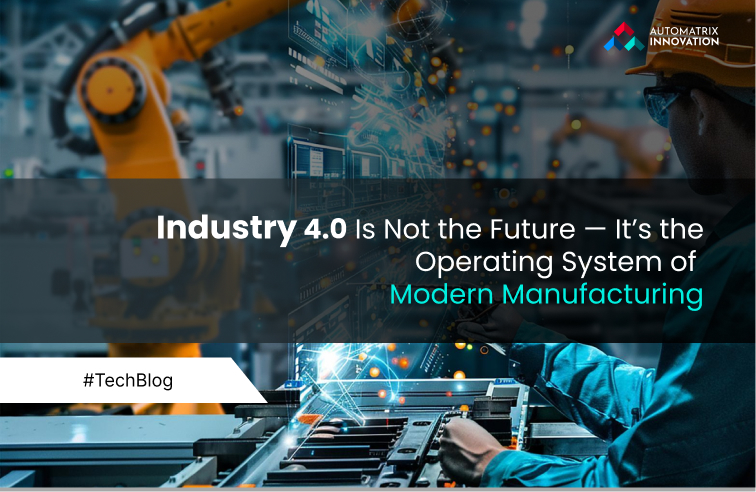
Manufacturing Has Entered a New Operating System
For decades, manufacturing success was defined by scale, efficiency, and cost control. But in today’s hyper-competitive global market, those factors alone are no longer enough. Rising customer expectations, supply chain disruptions, and increasing operational complexity demand something more powerful: intelligent, connected manufacturing systems.
This is where Industry 4.0 comes into play.
Industry 4.0 is not simply a trend or a future vision. It is rapidly becoming the operating system of modern manufacturing, integrating automation, artificial intelligence, industrial IoT, data analytics, and digital platforms to create smarter and more responsive industrial environments.
Manufacturers who adopt Industry 4.0 are no longer reacting to operational challenges — they are anticipating them through data, automation, and real-time intelligence.
What Industry 4.0 Really Means for Manufacturers
At its core, Industry 4.0 represents the convergence of physical manufacturing processes and digital technologies. Machines, systems, and people are connected through intelligent networks that continuously collect, analyze, and act on operational data.
This transformation enables manufacturing organizations to move beyond traditional workflows and toward autonomous and optimized production ecosystems.
Key technologies powering Industry 4.0 include:
- Industrial Internet of Things (IIoT) for real-time machine connectivity
- Artificial Intelligence and machine learning for predictive insights
- Robotic Process Automation (RPA) for operational efficiency
- Advanced data analytics for decision intelligence
- Cloud platforms and digital integration layers for system connectivity
Together, these technologies create smart factories capable of learning, adapting, and optimizing performance continuously.
The Rise of the Smart Factory
One of the most visible outcomes of Industry 4.0 is the emergence of the smart factory.
In a smart factory environment, machines communicate with each other, production systems automatically adjust to changing conditions, and managers gain real-time visibility into every stage of operations.
Instead of relying on manual reporting or delayed insights, manufacturers can now:
- Monitor production performance in real time
- Predict equipment failures before they occur
- Optimize supply chain coordination
- Reduce downtime and operational inefficiencies
- Improve product quality through data-driven insights
Smart factories shift manufacturing from a reactive model to a predictive and autonomous operational framework.
Why Digital Workforce Automation Matters in Industry 4.0
While connected machines are essential, Industry 4.0 extends far beyond the factory floor. Administrative operations, compliance processes, procurement workflows, and supply chain coordination also need to evolve.
This is where digital workforce automation becomes critical.
Digital workforce solutions automate repetitive tasks such as:
- Invoice processing and reconciliation
- Inventory and procurement updates
- Compliance documentation and reporting
- Order processing and logistics coordination
- Data validation and system integration
By automating these operational layers, manufacturers can eliminate manual bottlenecks, reduce errors, and enable faster decision-making across the organization.
The Competitive Advantage of Industry 4.0
Manufacturers that successfully implement Industry 4.0 gain a powerful competitive edge. Instead of relying on rigid production systems, they operate through intelligent and adaptive manufacturing ecosystems.
The benefits are substantial:
Operational Efficiency
Automated processes reduce manual workloads and increase production speed.
Real-Time Visibility
Integrated data platforms provide complete operational transparency.
Predictive Maintenance
AI-driven insights identify potential failures before they disrupt production.
Supply Chain Resilience
Connected systems enable better demand forecasting and inventory planning.
Scalable Operations
Digital infrastructure allows manufacturers to scale production without proportional cost increases.
In short, Industry 4.0 enables organizations to operate faster, smarter, and more strategically.
How Automatrix Innovation Is Enabling Industry 4.0 Transformation
Adopting Industry 4.0 requires more than implementing isolated technologies. It requires a strategic transformation of processes, platforms, and operational intelligence.
This is where Automatrix Innovation plays a critical role.
Automatrix Innovation helps manufacturers design and implement end-to-end Industry 4.0 ecosystems that integrate automation, intelligent workflows, and data-driven operations.
Through its advanced automation and digital transformation solutions, Automatrix Innovation enables organizations to:
- Build connected manufacturing environments
- Implement digital workforce automation
- Integrate enterprise systems and operational data
- Deploy AI-driven analytics and automation platforms
- Optimize production, supply chain, and administrative processes
By combining technology expertise with deep operational understanding, Automatrix Innovation helps manufacturers move from fragmented digital initiatives to fully integrated Industry 4.0 strategies.
The Future of Manufacturing Is Already Here
Industry 4.0 is no longer an experimental concept reserved for early adopters. It has become the foundation for modern industrial competitiveness.
Manufacturers that delay this transformation risk falling behind more agile, data-driven competitors. Those that embrace Industry 4.0 today position themselves to lead tomorrow’s industrial landscape.
With intelligent automation, connected systems, and real-time operational insight, manufacturers can unlock a new level of productivity, innovation, and resilience.
And with the expertise and technology leadership of Automatrix Innovation, organizations can confidently transition into the next generation of manufacturing excellence.
FAQs
What is Industry 4.0 in manufacturing?
Industry 4.0 refers to the integration of advanced digital technologies such as IoT, artificial intelligence, automation, and data analytics into manufacturing systems. It enables smart factories where machines, systems, and processes communicate and optimize operations in real time.
Why is Industry 4.0 important for modern manufacturing?
Industry 4.0 improves operational efficiency, reduces downtime, enhances product quality, and provides real-time visibility across production systems. It allows manufacturers to respond quickly to changing market demands while optimizing productivity.
What technologies drive Industry 4.0?
Key technologies behind Industry 4.0 include Industrial IoT, artificial intelligence, machine learning, robotics, cloud computing, advanced analytics, and automation platforms that integrate manufacturing and business systems.
How does automation support Industry 4.0?
Automation eliminates repetitive manual tasks, improves process accuracy, and speeds up operational workflows. When combined with data analytics and intelligent systems, automation enables predictive and autonomous manufacturing environments.
How can Automatrix Innovation help manufacturers adopt Industry 4.0?
Automatrix Innovation helps organizations implement Industry 4.0 strategies by integrating automation platforms, connected manufacturing systems, digital workforce technologies, and intelligent analytics to create smarter and more efficient industrial operations.